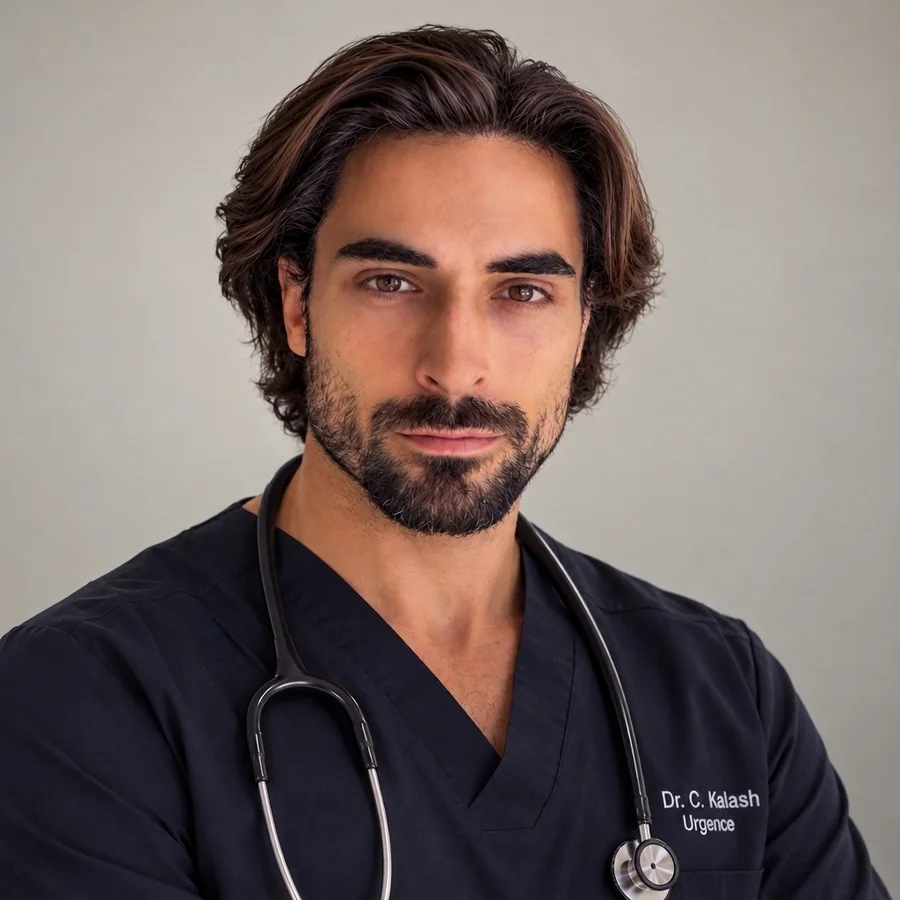
I could sum up my plan in a few sentences. Putting it on paper took much longer.
I think back to those visits for first-trimester bleeding. The patient assessed, the plan made, there were always the same five documents left to fill in and the same information to copy over. Ten minutes or so, every time, while other patients waited.
“I should be able to tell an assistant ‘follow-up in ambulatory medicine,’ then move on to the next patient while it prepares the paperwork.”
Those documents were not pointless. But nothing required redoing them by hand, every time.
And it was not only the paperwork. I had to keep the possibilities in mind, not forget a test, spell out an order, go back to a source. I wanted an assistant that would start from the same case, to help me think and prepare what comes next.
- Université de MontréalFamily medicine
- Hôpital de VerdunResidency, electives in critical care
- Sorel, Pierre-Boucher, BrossardEmergency department, intensive care, family medicine clinic
- Hôpital du Haut-RichelieuEmergency department and intensive care in Saint-Jean, then night shifts in the ED
- AtomicMDFull time since 2026
Before the software, there was the practice.
I trained in family medicine at Université de Montréal and did my residency at Hôpital de Verdun. Critical care already drew me: I took all my electives there. I was called to the intensive care unit to place central lines, day and night, even when I was neither on rotation there nor on call.
I started my practice in three settings at once: the emergency department in Sorel, intensive care at Hôpital Pierre-Boucher, and a family medicine clinic in Brossard, where I followed 500 patients and did walk-in clinics. I often worked every day of the month: that was the norm rather than the exception.
After three years, I moved my practice to Hôpital du Haut-Richelieu, in Saint-Jean-sur-Richelieu, for the emergency department and intensive care, while keeping Pierre-Boucher and the clinic.
So I have known several realities of medicine: following patients over the years, assessing problems that are still undifferentiated, deciding under uncertainty in the emergency department, treating critical situations in intensive care.
Everywhere, I found the same difficulty: the room taken up by the tasks around care. Writing notes, filling in forms, preparing requisitions, organizing follow-ups, copying information already recorded elsewhere.
It was not a problem specific to the emergency department. I lived it in each of my practices.
More than a scribe.
For years, I had been following artificial intelligence closely: courses, reading, every new tool put to the test.
Faced with a complex case, in the emergency department or in intensive care, I would sometimes describe the clinical picture to a language model. It often gave me useful leads, and several colleagues tried it with me.
The arrival of AI scribes was a step forward. But the note was only part of the problem. There were still the orders, the forms, the requisitions, the billing. And there was still clinical reasoning: going back over a difficult case, considering another hypothesis, checking a course of action.
The assistant I imagined had to connect the two: understand the case to help me think, then use it to prepare the administrative work, without having to be told the story again at every step.
An assistant to reason with, and to hand part of the paperwork to.
The technology existed. The tool did not, and I saw no one building it.
I decided to build it.
In the hospital, our tools were not up to what technology already made possible. I saw colleagues who were burned out, holding everything in their heads from the start of the shift to the end: the diagnoses to consider, the orders to write after each patient, the pearls not to forget, the forms to fill out. I knew AI could already take a good part of that effort off their hands, so they could keep their energy for their decisions and for being present with their patients.
At the start of 2026, I took a break from my practice. After stepping back and regaining my energy, I devoted myself to this project, which I had been sketching for years.
It became my daily work.
Hundreds of versions.
Dictation came first, then the reasoning engine. Each was tested on simulated cases: I reviewed its suggestions and reworked whatever fell short. Every module went through that back-and-forth.
Colleagues tried the prototypes and encouraged me to carry on. I knew what I wanted to build, and I kept going.
Little by little, the pieces came together. Today, you dictate the visit. AtomicMD writes the note, suggests a differential diagnosis and offers you the orders and forms, already filled in. It also reviews the note for billing. You check and sign. See the workstation
What the studies say.
Since 2025, research has been measuring what these tools bring. In randomized trials, physicians assisted by a language model reasoned better on clinical vignettes than without that help, with a statistically significant difference. Other studies, including one in the emergency department, show less time spent on documentation and less burnout.
These studies are about other tools than mine. They say what this technology can bring, not what AtomicMD is worth. See the studies
When a treatment is shown to be superior, it becomes the standard. I believe the same will happen with AI in medicine, as the evidence accumulates.
Being able to check what it suggests.
A convincing answer is not necessarily a correct one. A model can make up a fact and write it with the same confidence as everything else. AtomicMD can make mistakes, or leave out something important. How an AI answers
Physicians make mistakes too, as we all know. We are not asked to be infallible: we are asked to know our limits and to check our work. A tool like this asks the same of those who use it: knowing where it can go wrong, and reading its suggestions with a critical eye.
That is what I designed it for. You can examine its suggestions, understand the reasons given and weigh them against the patient in front of you. It suggests, you decide. AtomicMD Source cites its sources for the same reason: guidelines from Québec and elsewhere, and the protocols you add to it.
“In my view, the benefit outweighs the risk, provided we keep that critical eye.”
My own tests helped me improve it and learn its limits. They are not clinical studies.
Starting with the reality I know.
AtomicMD is intended first for Québec emergency physicians. It is the practice I identify with, and the one whose constraints I know best.
The forms, the requisitions, RAMQ billing and the clinical resources used here are not details to add at the end. They are part of the daily work I want to simplify. The billing software has been certified by RAMQ since September 2026, and AtomicMD is a billing agency registered with RAMQ.
The same standard applies to confidentiality and security. Working with health information takes more than a convenient application: its protection, access to it and the risks tied to AI must be taken seriously. Your data is hosted and processed in Montréal, and AtomicMD is TGV-certified by Santé Québec. See the Trust page
What comes next will be built with colleagues.
I designed AtomicMD from my own experience. But it does not represent every way of practising.
I want to know what saves you time, what slows you down, what is missing and what deserves a second look. Your feedback should guide what comes next, not arrive once the decisions are made.
AtomicMD evolves week after week, with your feedback and with the progress of the models.
I chose to work on the tools physicians use: I believe that is where I can be most useful. I want to start with emergency medicine, then extend this approach to other medical practices in Québec.
I created AtomicMD so that we spend less time redoing the same tasks, and more time exercising our judgment, treating and being available for our patients.
Charles KalashEmergency physician and founder of AtomicMD
Free until March 5, 2027, no card. Try it free